
SMUGGLERS’ NIGHTMARE: How Idiroko Customs is choking ₦9.5bn contraband pipeline
By Innocent Chukwu
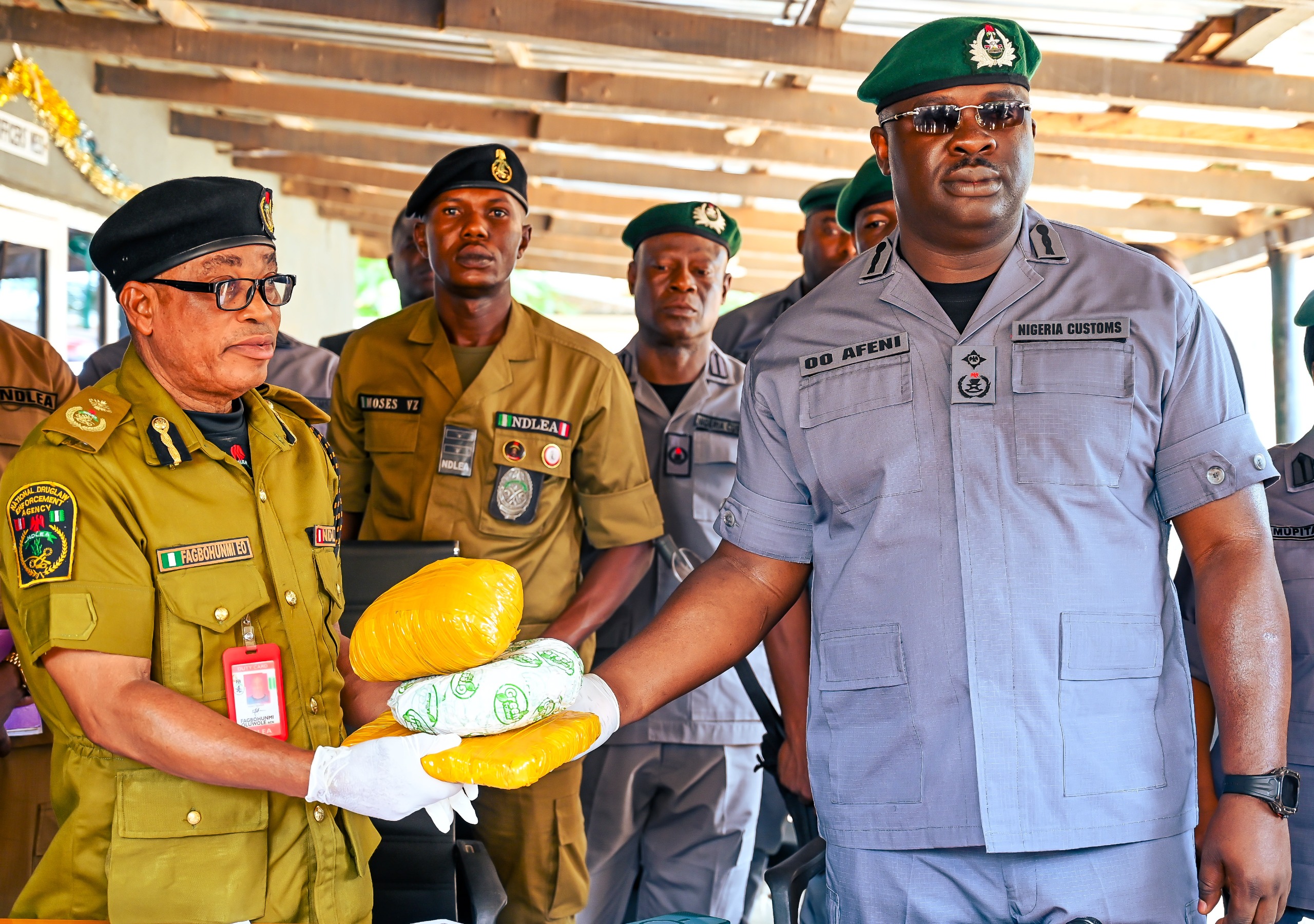
OGUN 1 COMMAND AND DEPUTY COMPTOLLER AFENI AND THE BATTLE FOR THE NIGERIAN MARKET
For the smuggler sneaking through a bush path at Idiroko, the border is becoming a dangerous place.
For the Nigerian farmer struggling to sell locally produced rice, the manufacturer fighting to keep his factory running, the legitimate trader paying duties and the government battling to raise revenue, however, what is happening at the Nigeria-Benin Republic border represents something bigger than a Customs enforcement operation.
It is a battle for the Nigerian market.
At the Ogun I Area Command of the Nigeria Customs Service, Idiroko, billions of naira worth of prohibited goods have been intercepted in a sustained crackdown that has put rice, petroleum products, narcotics, pharmaceuticals, tyres, clothing, sugar, fertiliser, vegetable oil and other contraband under intense scrutiny.
Between February and August 2026, the Command recorded seizure windows worth approximately ₦9.55 billion in Duty Paid Value — about ₦1.35 billion between February and March, ₦4.628 billion between April 1 and June 23, and another ₦3.574 billion between June 24 and August 13.
But the real story is not the size of the seizure warehouse.
It is what those seizures mean for the ordinary Nigerian.
Every consignment of foreign rice stopped at the border is potentially a market opportunity for a Nigerian farmer. Every illicit pharmaceutical intercepted could mean one less dangerous product reaching a consumer. Every illegal fuel consignment stopped represents an attempt to protect the legitimate downstream market.
And every narcotics shipment seized takes another dangerous product out of circulation.
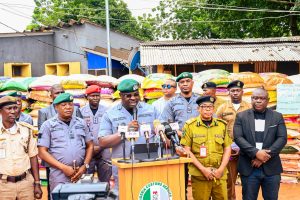
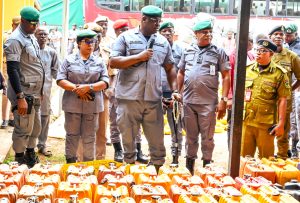
At the centre of the operation is Deputy Comptroller Oladapo Afeni, Acting Customs Area Controller of Ogun I Command, whose strategy appears increasingly built around one proposition: make smuggling expensive, risky and difficult, while making legitimate trade easier and more profitable.
That strategy is rapidly turning Idiroko from merely a notorious smuggling corridor into an important testing ground for Nigeria’s economic-security ambitions.
THE ₦3.574BN HAMMER
The latest blow came between June 24 and August 13, 2026.
During the period, Ogun I intercepted prohibited goods with a combined Duty Paid Value of ₦3,574,435,248.08. The operation produced an extraordinary catalogue of contraband.
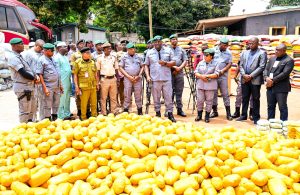
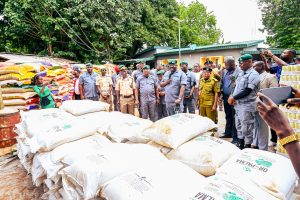
There were 6,035 parcels of Ghana Loud/Indica, 2,339 bags of foreign parboiled rice, 70 cartons of basmati rice, 30 bags of foreign sugar, 11,450 litres of Premium Motor Spirit in kegs, another 1,750 litres of PMS in drums and 30 kegs of diesel.
There were also 100 bags of fertiliser, 67 bales of second-hand clothing, 2,674 pieces of new shorts and trousers, 3,760 pieces of new tops, 85 fire extinguishers, 480 cartons of Pure Haven drinks, cosmetics, oats, hair accessories, surgical shoes and 127 new purses.
The diversity of the seizures tells its own story.
Smuggling at Idiroko is not a single-product business.
It is an organised underground economy moving whatever can generate profit outside the formal trade system.
And increasingly, that economy is colliding with national security.
The 6,035 parcels of Ghana Loud/Indica were handed over to the National Drug Law Enforcement Agency, NDLEA, Idiroko Special Command, for further investigation and necessary action.
Afeni disclosed that from January 2026 to the August briefing, the Command had handed over 32,412 parcels of hard drugs and 92 sacks of raw Cannabis Sativa to the NDLEA Idiroko Special Command.
The border battle, therefore, has moved beyond customs revenue.
It has become a fight over what enters the country, who profits from it and what consequences those illegal imports impose on society.
BEFORE THE ₦3.57BN CAME ₦4.63BN
The latest operation was preceded by another major enforcement window.
Between April 1 and June 23, 2026, Ogun I recorded 146 seizures with a cumulative DPV of ₦4,628,591,970.16.
More significantly, the Command generated ₦259,777,346.89 during the same period.
That was a 238 per cent increase over the ₦76.81 million collected during the corresponding period of 2025.
The revenue performance matters.
It suggests that the Customs operation is not simply about confiscating goods.
It is also about bringing economic activity back into the formal system.
The second-quarter seizure list included 2,807 bags of foreign parboiled rice, 9,482 parcels of Cannabis Sativa, 62 sacks of raw marijuana, 16,525 litres of PMS, 475 litres of diesel, 7,642 pieces of footwear, 2,427 pneumatic tyres, 63 sacks of foreign sugar, 73 bales of second-hand clothing, fertiliser, imported flour, frozen products and pharmaceuticals.
The Command handed over 6,981 parcels of Cannabis Indica/Ghanaian Loud and 62 sacks of raw marijuana to the NDLEA.
It also transferred illicit pharmaceutical products, including 77 cartons of Analgin injections containing 138,600 tubes, to NAFDAC.
The numbers reveal an enforcement operation increasingly dependent on collaboration. Customs intercepts.
NDLEA investigates narcotics.
NAFDAC handles dangerous pharmaceutical products.
Other security agencies contribute intelligence and operational support.
The border, in effect, is becoming a multi-agency security theatre.
THE ₦1.35BN WARNING SHOT
Then came the earlier chapter.
Between February and March, the Command intercepted prohibited goods valued at approximately ₦1.35 billion.
The seizures included 2,539 kegs of vegetable oil, 4,325 cartons of foreign spaghetti, 1,204 bags of foreign parboiled rice, 2,547 parcels of Cannabis Sativa and 13,625 litres of PMS.
Four live pangolins and two antique artefacts believed to date from the 19th century were also intercepted.
The vegetable oil seizure carried an economic message.
Customs said it was aimed at protecting local producers from unfair competition created by smuggled products.
That is the point at which border enforcement intersects with the wider Renewed Hope economic agenda.
A Nigerian manufacturer who pays taxes, employs workers and complies with regulations cannot realistically compete with a smuggler who avoids duties and regulatory controls.
The same applies to the farmer.
The same applies to the legitimate importer.
The same applies to the trader operating within the law.
Smuggling, therefore, is not victimless.
Its hidden victims may include the factory worker whose employer cuts production, the farmer who cannot sell his harvest and the legitimate trader whose business is squeezed by cheaper illicit imports.
RICE: THE BORDER’S BIGGEST ECONOMIC BATTLE
If there is one commodity that symbolises the struggle at Idiroko, it is foreign rice.
Rice repeatedly appears in Afeni’s seizure diary.
Between April and June alone, 2,807 bags of foreign parboiled rice were intercepted.
Between June 24 and August 13, another 2,339 bags, alongside 70 cartons of basmati rice, were seized.
For Customs, the argument is simple.
Illegal rice imports undermine Nigerian farmers, rice mills and investors who have put money into domestic production.
The economic contradiction is obvious.
Government encourages Nigerians to produce more food locally. Farmers invest. Processors invest. Milling capacity expands.
Then smugglers exploit porous borders to flood the same market with prohibited imports.
The border, therefore, becomes the first line of defence for domestic production.
Every intercepted bag of foreign rice represents more than a seizure.
It represents a market contest.
And the question is whether Nigerian producers can eventually win that contest on the strength of productivity, quality and competitive pricing rather than permanent border protection.
WHEN SMUGGLERS TURN AGGRESSIVE
But the smuggling business is not surrendering quietly.
In one June operation, Customs officers intercepted a truck carrying 113 bags of foreign parboiled rice along the Itori-Wasimi-Abeokuta corridor.
According to the Command, the driver ignored the officers’ signal to stop and attempted to ram the patrol vehicle before he was apprehended.
In another operation, 630 bags of foreign rice were intercepted along the Afamin-Igbogila axis.
Earlier operations had also involved resistance and attacks on Customs personnel.
That changes the character of the operation. These are not merely commercial disputes between traders and regulators.
Customs personnel are confronting networks prepared to evade checkpoints, exploit difficult terrain and, in some instances, challenge enforcement officers.
It explains why intelligence has become increasingly central to the Afeni strategy.
THE NEW BORDER WAR: INTELLIGENCE
The old image of anti-smuggling operations was largely about patrols, checkpoints and vehicle searches.
The new battle is more sophisticated.
Smugglers use bush paths. They move at night. They conceal consignments.
They break large shipments into smaller quantities.
They exploit abandoned structures, waterways and multiple routes.
So Customs has had to adapt.
The August operation, according to the Command, was strengthened by intelligence gathering, technology and collaboration with sister security agencies. That intelligence-led approach is becoming critical to disrupting smuggling networks before the goods reach Nigerian markets.
The objective is no longer simply to stop a truck.
It is to identify the network behind the truck.
That distinction could determine whether the war against smuggling produces temporary victories or lasting results.
BUT IDIROKO IS NOT ONLY ABOUT SEIZURES
There is another side of the story.
While the seizure figures have risen, legitimate trade has also begun to emerge more prominently.
Between April and June, Ogun I facilitated 20,972 metric tonnes of exports with a Free-On-Board value of ₦1.049 billion.
That was a dramatic improvement over the corresponding period of 2025, when no export activity was recorded.
By the August briefing, the Command reported 10,110 metric tonnes of exports valued at ₦2.594 billion FOB, with white talc, crushed thermal coal and CNG among the major export commodities.
That development could ultimately prove more important than the seizures.
Because a border that only stops goods is not necessarily a successful border.
A successful border must distinguish between the criminal and the legitimate.
It must be a filter, not a wall.
The illegal must be stopped.
The legitimate must move.
That is the delicate balance facing Ogun I.
THE AFENI EQUATION
The emerging Afeni model can be reduced to four words:
Enforcement. Revenue. Security. Trade.
The enforcement figures are substantial.
The revenue numbers are improving.
The narcotics handovers demonstrate the security dimension.
The export figures point towards trade facilitation.
And all four are connected.
A secure border encourages legitimate commerce.
Legitimate commerce generates revenue.
Revenue strengthens government capacity.
Strong enforcement protects legitimate businesses from unfair competition.
That is the economic-security equation playing out at Idiroko.
THE ₦9.5BN QUESTION
Yet there is a bigger question hiding behind the billions of naira in seizures.
If Customs can intercept approximately ₦9.55 billion worth of prohibited goods across the three seizure windows, how much more is getting through?
The answer is impossible to establish from seizure figures alone.
And that is why the success of Ogun I cannot ultimately be measured only by the size of its seizure yard.
Every seizure proves that Customs has stopped something.
But the continued appearance of rice, fuel, narcotics, clothing, pharmaceuticals and other prohibited products proves something else: The he smuggling economy is still profitable.
As long as the incentives remain, smugglers will keep looking for routes.
This means enforcement must be accompanied by broader economic measures. Border communities need legitimate economic opportunities.
Traders need predictable procedures.
Exporters need efficient processing.
Law-abiding importers need clarity.
Security agencies need sustained cooperation.
And Customs must ensure that the legitimate trader does not become collateral damage in the war against criminal networks.
THE RENEWED HOPE TEST
That is where the Tinubu administration’s Renewed Hope agenda faces its real border test.
The test is not simply how many bags of rice Customs can seize.
The test is whether the seizures eventually help create an economy in which Nigerian farmers can compete, manufacturers can remain in business, legitimate traders can make profits, government can collect lawful revenue and criminal networks can no longer exploit Nigeria’s borders as an economic highway.
By that measure, the Ogun I experience is significant. There is the ₦1.35 billion seizure chapter of February-March.
There is the ₦4.63 billion recorded between April and June. And there is the ₦3.574 billion seizure window from June 24 to August 13.
Together, they underline the intensity of the enforcement campaign.
Behind the figures is an increasingly diversified contraband economy involving drugs, rice, petroleum products, vegetable oil, tyres, pharmaceuticals, clothing, sugar, fertiliser, wildlife and antiquities.
But alongside the seizures are drug handovers, inter-agency operations, revenue collection and legitimate exports.
That combination could become the more enduring measure of success.
THE DIARY IS STILL OPEN
As August 2026 closes, Idiroko is increasingly becoming more than a Customs collection point.
It is an economic-security frontline.
For smugglers, the message is blunt:
The routes are being watched. The networks are being pursued. The cargoes are increasingly vulnerable.
For legitimate businesses, the message is different: The border is expected to become a safer and more predictable gateway for lawful commerce.
For Nigerian farmers and manufacturers, the stakes are even higher.
If the smuggling pipeline is squeezed, will they finally gain the market space they have long demanded?
For government, the question is whether stronger border enforcement can translate into more domestic production, more jobs, more revenue and greater economic security. And for the Renewed Hope agenda, that is the real scorecard.
Not the mountain of seized rice.
Not the number of intercepted trucks.
Not even the billions of naira in Duty Paid Value.
The ultimate victory will be measured by the size, strength and competitiveness of the legitimate Nigerian economy that emerges after the smuggling economy is squeezed out.
At Idiroko, that battle is still raging.
And for the smugglers, the nightmare is only beginning.