
Apapa Customs hits record ₦323bn in July, Oshoba credits reforms, forex stability

By Maureen Aguta
The Nigeria Customs Service (NCS), Apapa Area Command, has recorded its highest-ever monthly revenue collection of ₦323 billion in July 2026, consolidating the Command’s position as a major revenue engine of the Service.
The latest record came under the leadership of the Customs Area Controller (CAC), Comptroller Emmanuel Oshoba, who had earlier led the Command to another historic collection of ₦304 billion in October 2025.
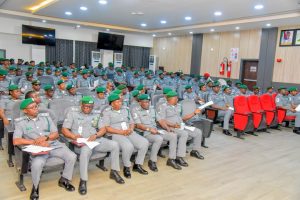
Oshoba disclosed the July performance on Tuesday, August 11, during the Command’s monthly meeting with Deputy Comptrollers in charge of terminals and Unit Heads, attributing the feat to a combination of Customs reforms, improved compliance, intelligence-driven enforcement and a more predictable operating environment.
He particularly credited the modernisation programme of the Comptroller-General of Customs, Bashir Adewale Adeniyi, MFR, PhD, and the management team of the Service, saying the reforms had significantly streamlined Customs operations and improved revenue performance.
“We recognise and acknowledge the CGC’s devotion and dedication to the modernisation project of the Nigeria Customs Service. The management team has introduced several innovations that have streamlined our activities and given us clear direction,” Oshoba said.
According to him, the improved performance of the B’Odogwu digital system, which initially encountered operational challenges, has contributed to better processing and revenue outcomes at the Command.
He also identified the One-Stop Shop (OSS) initiative as another major reform driving efficiency, noting that it had helped reduce cargo delivery time and created greater predictability for importers and other port users.
Oshoba further pointed to the Authorised Economic Operator (AEO) programme, which he said currently has more than 200 beneficiaries, as an initiative that has positively influenced the revenue profile of the Command.
Beyond technology and institutional reforms, the CAC said intelligence-led enforcement had strengthened compliance by enabling officers to detect false declarations and ensure that importers complied with approved Customs valuation principles.
He also linked the improved revenue performance to the relative stability of the foreign exchange market under the administration of President Bola Ahmed Tinubu, saying greater predictability in the forex environment had enabled businesses to plan their import operations with more confidence.
According to Oshoba, the combination of policy reforms and forex stability has created an operating environment in which legitimate businesses can make better-informed decisions and comply more effectively with Customs requirements.
But the CAC warned officers against measuring their performance solely by the revenue generated through routine transactions, challenging them to identify their individual contributions to enforcement and trade facilitation.
“In your Area of Responsibility, you must ask yourself, apart from the normal revenue generated by your Unit, what is your own contribution in terms of intervention? What have I added?” he asked.
The Customs boss also stressed the importance of trade facilitation and ease of doing business, directing officers to resolve disputes promptly while ensuring that consignments requiring further scrutiny were subjected to proper documentation and the Post Clearance Audit (PCA) process.
On relations with stakeholders, Oshoba charged officers to adopt a more professional and humane approach in dealing with importers, agents and other port users.
“When you interact with stakeholders, let them leave your office with hope rather than despair. As a leader, do not allow anyone who comes to you to depart feeling hopeless or depressed. Give people hope,” he said.
He commended stakeholders and sister government agencies for their cooperation, saying their support had contributed to improved compliance and greater sanity in the port business environment.
Oshoba, however, warned officers against complacency, urging them to sustain transparency, discipline and professionalism while keeping pace with rapidly evolving digital Customs processes.
He called for greater consultation among officers, continuous in-house training, effective supervision and strict adherence to approved procedures.
The CAC also urged Staff Officers to support Deputy Comptrollers in maintaining discipline while building a workplace culture founded on teamwork, empathy and concern for the welfare of subordinates.
With the July revenue record now setting a new benchmark for the Command, Oshoba charged officers to regard the achievement not as an end in itself but as a platform for further improvements before the end of the year.
He commended officers and compliant stakeholders for the performance, urging them to sustain the momentum and pursue higher levels of productivity, revenue mobilisation and trade facilitation in the remaining months of 2026.