

Denmark to Nigeria: Stronger partnerships key to unlocking blue economy
Maureen Aguta
Denmark has called for stronger collaboration among government agencies, private investors, businesses and other stakeholders as Nigeria seeks to unlock the vast economic potential of its maritime and blue economy.
The Danish government said greater coordination and strategic partnerships were critical to developing efficient ports, strengthening marine infrastructure, creating jobs and positioning Nigeria as a major maritime hub in Africa.
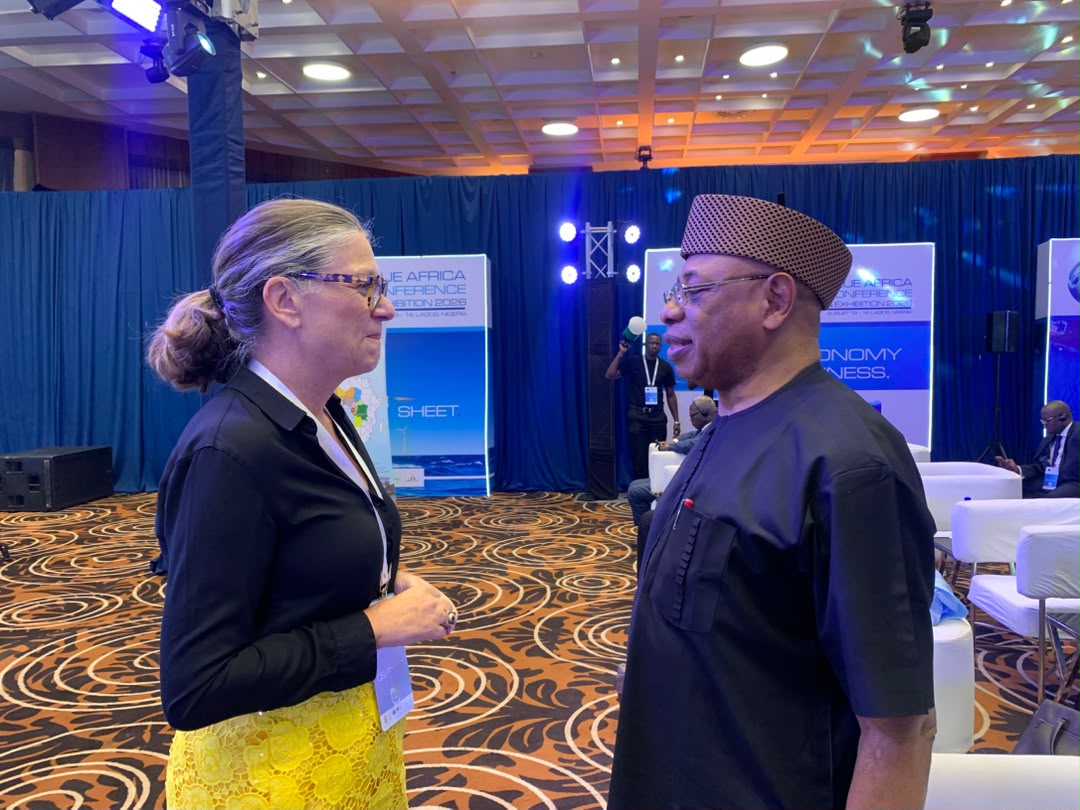
Speaking at the maiden Blue Africa Conference and Exhibition 2026 in Lagos, the Danish Consul General and Head of Economic Diplomacy, Jette Bjerrum, said Denmark’s experience had demonstrated that a vibrant maritime economy could not be built by government alone.
Bjerrum said Denmark had successfully developed its maritime industry through sustained collaboration between government institutions, the private sector, educational institutions and other stakeholders.
According to her, Nigeria could draw valuable lessons from the Danish model by bringing all relevant players together to develop policies and investments capable of driving the entire maritime value chain.
She said: “Food security, food loss, logistics and transportation, also at sea, are very, very important to bring these things together.”
Bjerrum stressed that maritime development should also be viewed beyond ports and shipping, noting that the sector was closely linked to agriculture, food security, transportation, logistics and industrial development.
She said stronger integration across these sectors would help Nigeria reduce food losses, improve the movement of agricultural products and strengthen supply chains.
The Danish envoy also highlighted the contribution of Danish companies, particularly Maersk and APM Terminals, to Nigeria’s maritime sector.
She said the companies had made significant investments in port infrastructure, equipment, electrification and human-capital development, while also working with Nigerian authorities on policies aimed at improving the operating environment.
“Maersk and APM Terminals have invested heavily in Nigeria, in the port setups, in education, in electrification of the ports, in equipment and also standing shoulder to shoulder with the authorities in order to develop policies that work for everybody,” she said.
Bjerrum also identified digitalisation as a major driver of efficiency in the maritime industry, saying the emergence of new technology companies and the transition from manual to digital processes could transform operations across the maritime value chain.
She urged stakeholders to embrace innovation and ensure that digital solutions were integrated into efforts to modernise Nigeria’s maritime sector.
The Danish representative further advocated a full value-chain approach, warning against fragmented efforts by stakeholders working in isolation.
According to her, platforms such as the Blue Africa Conference provide an opportunity for stakeholders to identify common challenges, establish partnerships and develop practical solutions capable of producing measurable results.
She said the critical questions should be what stakeholders could achieve together, who needed to be involved and how projects could be financed.
Bjerrum also emphasised the importance of feasibility studies and pilot projects before embarking on large-scale investments.
She said innovative ideas should first be tested on a smaller scale, with successful projects subsequently expanded.
“You need to start small in an innovation way of thinking in order to scale up your big projects, but you need to start small in order to show that things can work,” she said.
She described Nigeria’s maritime sector as strategically important not only to Nigeria but also to Denmark and the wider West African region, stressing that stronger international partnerships would be essential to unlocking its potential.
Bjerrum expressed confidence that closer cooperation between Nigeria, Denmark, businesses, investors and development partners could accelerate the growth of the region’s maritime economy.
The Blue Africa Conference and Exhibition 2026, which opened in Lagos on Thursday, is a two-day event holding at the Lagos Continental Hotel, Victoria Island.
The conference brings together government officials, maritime operators, investors, development partners and other stakeholders to examine opportunities and challenges in Africa’s blue economy.
Discussions at the maiden edition are focused on how Africa can better harness its vast marine and maritime resources to stimulate economic growth, create employment, strengthen food security and promote sustainable development.
The conference is also expected to provide a platform for stakeholders to forge partnerships and develop investment and policy frameworks capable of turning Africa’s largely untapped blue economy into a major engine of development.