

Apapa Command Under Oshoba: How Nigeria’s busiest port became a revenue powerhouse and security fortress
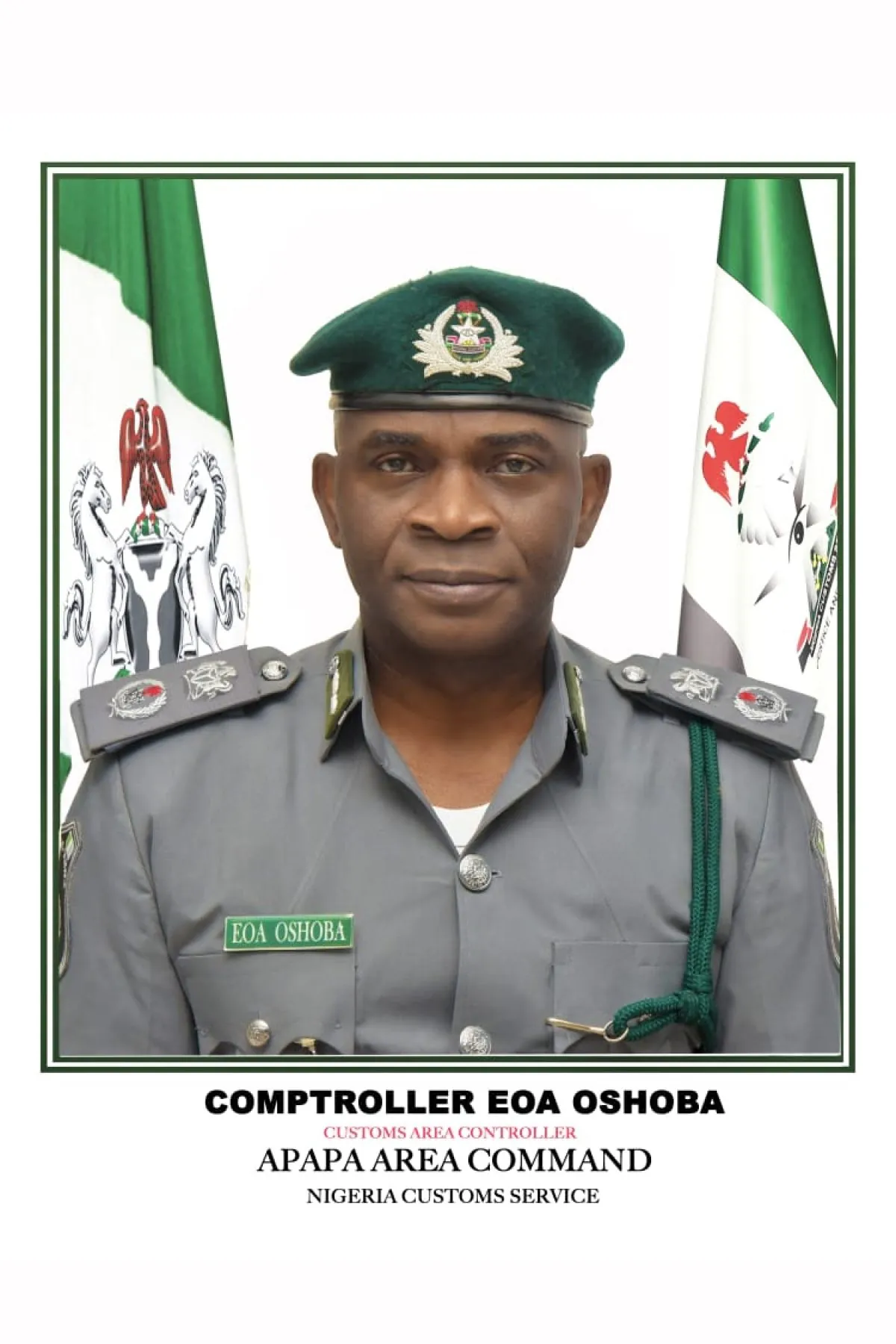
Maureen Aguta
When Comptroller Emmanuel Oshoba took charge of the Apapa Port Command in September 2025, the assignment came with familiar contradictions.
Apapa is Nigeria’s commercial nerve centre, handling the bulk of the country’s imports and exports, but it is also notorious for revenue leakages, sophisticated smuggling rings and periodic tensions with host communities.
Few expected how swiftly Oshoba would redraw the command’s narrative.
Within 24 hours of assuming office, Apapa shattered a national record, generating ₦20.1 billion in a single day — the highest daily revenue ever posted by any Customs command in Nigeria.
For Oshoba, however, the milestone was symbolic rather than celebratory. “It was not just about the numbers,” he told stakeholders at his maiden briefing.
“It was about sending a clear signal that Apapa under my watch will be a command of discipline, transparency and uncompromising enforcement.”
That signal has since defined a tenure increasingly viewed as transformational.
Resetting the Revenue Architecture
Oshoba’s first major intervention was the full deployment of the Unified Customs Management System (UCMS), popularly known as B’Odogwu.
The digital platform tightened processes, reduced human discretion and enabled real-time tracking of cargo and payments.
The results were immediate. Daily and monthly revenue collections consistently exceeded historical benchmarks.
Clearing agents reported fewer delays, clearer procedures and less uncertainty, while importers described the port as more predictable and transparent.
In an environment long plagued by bottlenecks, Apapa began to project fiscal discipline and operational clarity.
Enforcement Without Compromise
Yet revenue performance was only one side of Oshoba’s agenda. From the outset, he framed Apapa as both a trade hub and a frontline of national security.
That doctrine translated into an aggressive, intelligence-led enforcement regime.
By late 2025 and into early 2026, Apapa Port Command became synonymous with high-profile narcotics interceptions.
Working closely with the National Drug Law Enforcement Agency (NDLEA), Customs officers seized 347.5 kilograms of “Canadian Loud” cannabis concealed in a Toyota Sienna vehicle, hidden among 13 bags inside a container carrying four vehicles.
The seizures escalated. On January 2, 2026 — the first working day of the year — Customs and NDLEA operatives intercepted 30.1 kilograms of cocaine aboard MV Aruna, a Marshall Islands-flagged vessel at Greenview Terminal, Apapa. Earlier, 25.5 kilograms of cocaine had been discovered aboard another vessel, while on December 11, 2025, authorities uncovered a massive 1,187 kilograms of Canadian Loud cannabis packaged in 2,374 parcels and concealed in imported vehicles within a 40-foot container.
“These achievements reflect strong inter-agency synergy and our commitment to intelligence-led enforcement,” Oshoba said while commending officers involved in the operations. “While criminal elements seek to outsmart us, our officers remain one step ahead.”
The consistency and scale of the interceptions elevated Apapa’s profile as a critical battleground in Nigeria’s war against drug trafficking, reinforcing the command’s zero-tolerance stance against smuggling.
Beyond the Gates: Community Diplomacy
Oshoba’s strategy extended beyond cargo terminals and inspection bays.
Recognising that enforcement cannot succeed in isolation, he prioritised community engagement.
In September 2025, he paid a courtesy visit to the Ojora of Ijora and Iganmu Kingdom, stressing peaceful coexistence and cooperation.
“Port security is a shared responsibility,” he told community leaders. The outreach helped ease long-standing frictions, while sister agencies, including the Maritime Police, reported improved collaboration and intelligence sharing.
A Five-Pillar Legacy in Motion
Analysts increasingly describe Oshoba’s stewardship as resting on five interlinked pillars: record-breaking revenue generation; operational resilience through digitalisation; aggressive, intelligence-driven enforcement; community engagement; and global recognition — capped by the World Customs Organisation’s Certificate of Merit awarded to Oshoba for outstanding service.
The broader implications are significant. Streamlined processes have improved supply-chain efficiency. Transparency has boosted investor confidence. And decisive enforcement has strengthened Nigeria’s standing in global trade and security circles.
“Apapa under Oshoba is not just a port,” a maritime analyst observed. “It is a statement of intent — that Nigeria can facilitate trade while enforcing compliance.”
A Command Recast
As the Nigeria Customs Service advances its 2026 agenda, Apapa Port Command under Comptroller Emmanuel Oshoba stands out as a redefined institution. Here, innovation meets compliance, revenue growth aligns with national security, and community trust reinforces enforcement.
In a sector where imbalance is common, Apapa is increasingly seen as proof that effective leadership can deliver both prosperity and protection — positioning Nigeria’s busiest port as not just an economic gateway, but a strategic pillar of fiscal stability and security.