

MARCON Applauds Customs over 399 guns, N373.8m cannabis seizure at Tin Can
Maureen Aguta
The Maritime Correspondents’ Organisation of Nigeria (MARCON) has commended the Nigeria Customs Service (NCS) for intercepting a major consignment of firearms and cannabis-infused products at the Tin Can Island Port, Lagos, describing the seizures as a significant boost to Nigeria’s national security efforts.
MARCON, in a statement signed by its Secretary, Olamide Osho, on Monday, urged the Customs Service and other security agencies to intensify surveillance and intelligence gathering across the nation’s ports and borders to prevent criminal networks from exploiting legitimate maritime trade routes for the movement of prohibited goods.
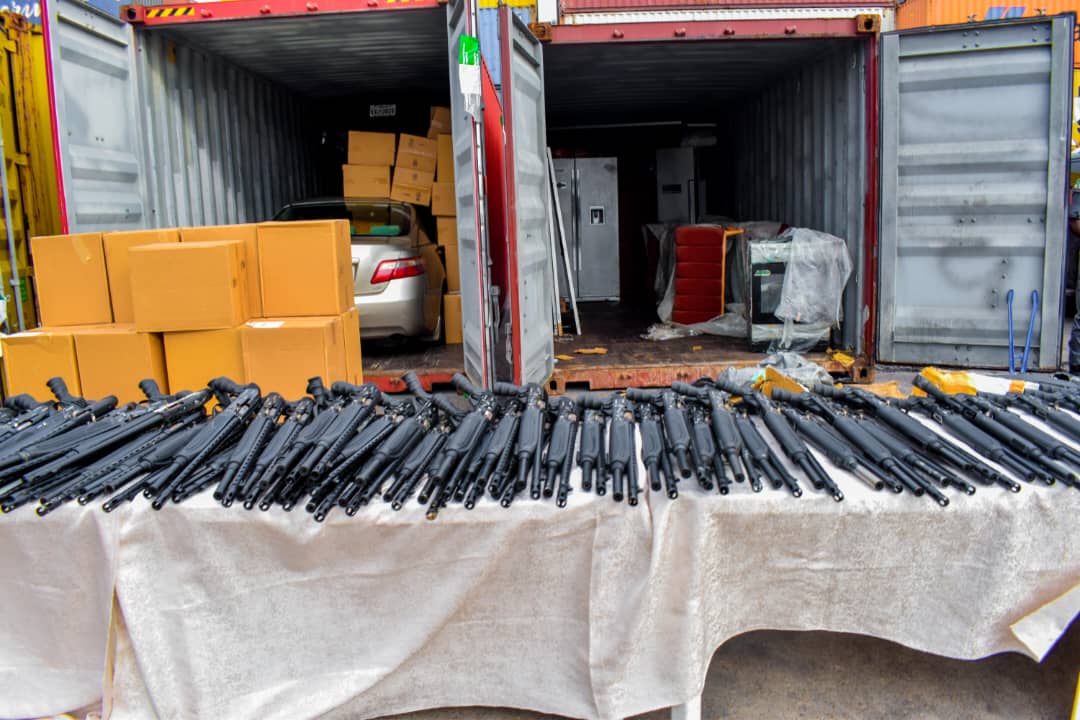
The organisation’s commendation followed the discovery of 399 fully assembled Jojef pump-action firearms and a large quantity of firearm components concealed in a container aboard the vessel MV VELIKA.
The vessel arrived at the Tin Can Island Port on July 8, 2026, but the container was subsequently flagged by the NCS intelligence-driven risk management system for enhanced scrutiny.
According to the Customs Service, an initial examination of the container uncovered concealed crates containing knocked-down components suspected to be Jojef firearms.
A detailed follow-up examination, including the coupling of the components, was completed on Sunday, August 9, leading to the recovery of 399 fully assembled firearms.
Customs officers also recovered 89 frames, 16 heat shields, 10 trigger pins, three pistons, 25 locking lugs, 80 charging handles, 39 pistol-grip screws, 34 springs, 57 trigger groups, 66 foregrip latches, 45 foregrips or handguards, four pistol grips and five barrels.
Two suspects have been arrested in connection with the arms consignment, while a third suspect described as a principal actor remains at large and is being tracked by security operatives.
MARCON said the interception demonstrated the importance of intelligence-led enforcement, risk profiling and physical examination in identifying attempts by criminal syndicates to infiltrate legitimate maritime supply chains.
The organisation also commended officers of the Tin Can Island Port Command and the Customs Enforcement Unit for their vigilance and professionalism in detecting the consignments.
Cannabis worth N373.8 million intercepted
In a separate operation, Customs officers at the command intercepted two 40-foot containers carrying cannabis-infused products concealed among used vehicles, generators, batteries and other imported items.
The seized products included 109 cartons of Delta-8 cannabis-infused pre-roll cookies, 125 cartons of Delta-8 cannabis-infused gummies and 73 cartons of cannabis-infused cookies.
The NCS put the combined street value of the seized cannabis products at N373.8 million.
MARCON said the interception further demonstrated the need for sustained cargo profiling and intelligence sharing among Customs and other agencies responsible for securing Nigeria’s maritime gateways.
Customs raises election security concerns
The seizures come against the backdrop of a warning by the Comptroller-General of Customs, Adewale Adeniyi, that criminal elements could seek to exploit Nigeria’s ports, land borders and airports ahead of the next general elections to smuggle prohibited items into the country.
Adeniyi said the Service would strengthen its enforcement operations to frustrate such attempts, while warning against internal compromise by Customs personnel.
He also disclosed that the seized firearms would be handed over to the National Centre for the Control of Small Arms and Light Weapons (NCCSALW), under the Office of the National Security Adviser (ONSA), for appropriate action.
For MARCON, the latest seizures underscore the strategic importance of Nigeria’s ports not only as gateways for international trade but also as critical fronts in the fight against transnational crime, arms trafficking and illicit drug movement.
The organisation called for deeper collaboration among the NCS, security agencies, port operators, shipping lines, freight forwarders and other maritime stakeholders to strengthen information sharing and early-warning mechanisms.
It stressed that effective port security should not be achieved at the expense of legitimate trade, but through smarter risk management capable of separating compliant cargo from shipments linked to criminal activities.
MARCON maintained that sustained investment in technology, intelligence gathering, cargo profiling and inter-agency coordination would be essential to keeping Nigeria’s maritime gateways secure while preserving their role as engines of commerce and economic development.