

Customs CGC Adeniyi moves to plug corruption gaps, launches risk-mapping framework
By Maureen Aguta
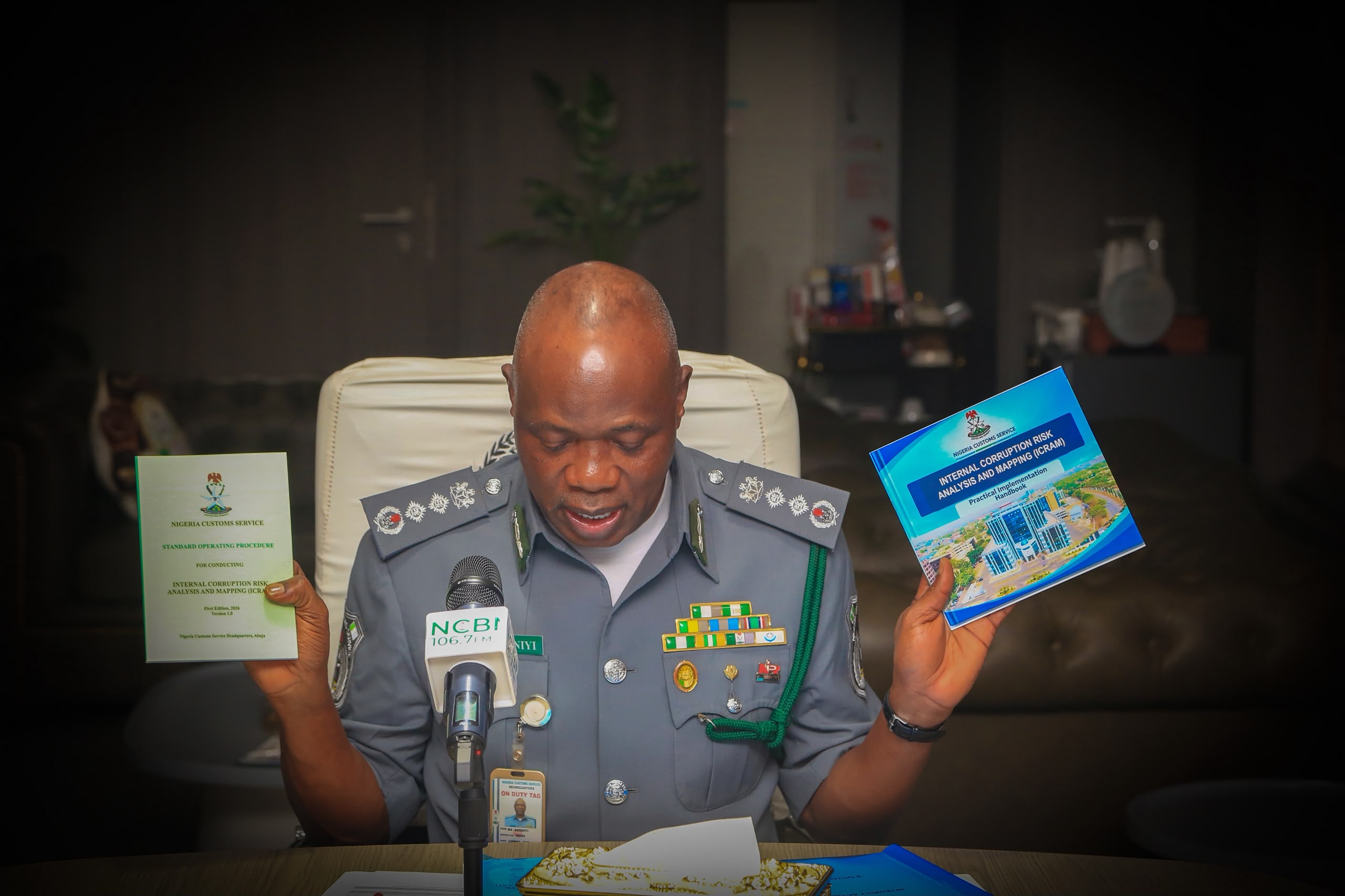
The Comptroller-General of the Nigeria Customs Service (NCS), Adewale Adeniyi, has stepped up the Service’s anti-corruption drive with the rollout of a new internal framework designed to identify, map and close corruption risks across its operations.
Adeniyi, on Tuesday, October 6, 2026, signed three key integrity documents — the Standard Operating Procedure (SOP) for Internal Corruption Risk Analysis and Mapping (ICRAM), the ICRAM Handbook and the Integrity Action Plan (IAP) — and ordered their immediate implementation across all Customs zones, commands and units.
The CGC also formally activated the ICRAM Steering Committee, signalling the beginning of a service-wide process to systematically examine operational and administrative procedures for vulnerabilities that could facilitate corrupt practices.
The documents were presented by the Assistant Comptroller-General of Customs in charge of the Strategic Research and Policy Department, ACG Nafi’u Isyaku, at a ceremony held at the NCS headquarters in Maitama, Abuja.
Adeniyi said the initiative was the product of extensive collaboration between the NCS, the World Customs Organisation (WCO), His Majesty’s Revenue and Customs (HMRC) and other international Customs administrations.
He said the objective was to make integrity a practical component of Customs operations rather than merely a policy statement.
“These two documents are products of a painstaking process which we have undertaken with efforts from an internal team working together with our partners from the WCO and a number of other Customs administrations that have walked this path with us to ensure that we have a Service where integrity leads,” Adeniyi said.
According to him, the new framework provides Customs personnel operating at seaports, land borders and airports with practical tools for identifying corruption risks within their areas of responsibility and taking specific measures to address them.
“We want to believe that we have laid a practical step, very easy to follow, for all our operatives at the ports, the borders, and the airports, to be able to conduct corruption risk mapping in their places, giving them the opportunity and capacity to implement the action plan to instil integrity in our system,” he said.
The rollout followed a pilot exercise conducted across seven strategic commands and units of the NCS.
The pilot covered 66 processes cutting across regulatory, core Customs and support functions, providing the Service with a practical test of the ICRAM methodology before its wider implementation.
The participating formations were selected across the three major operational modalities.
Under the sea modality, the Apapa Area Command participated in the exercise, while the air modality covered the Murtala Muhammed Cargo (MMAC) and Murtala Muhammed International Airport (MMIA) Commands.
The Seme Area Command represented the land-border modality.
Specialised units involved in the pilot included the Customs Police Unit, Zone A; the PAAR Ruling Centre; and the Procurement Unit.
The exercise subsequently produced an Integrity Action Plan containing 101 major action items and 295 sub-action items aimed at addressing identified vulnerabilities across the processes reviewed.
Among the key interventions identified in the plan are greater automation of Customs processes, stronger supervisory controls and accountability mechanisms, improved audit trails and traceability, clearer segregation of duties and regular rotation of personnel.
The plan also provides for targeted training of officers and stronger controls governing interactions between Customs personnel and stakeholders.
The emphasis on automation and traceability is particularly significant because the framework seeks to reduce areas where excessive discretion, weak supervision or inadequate documentation could create opportunities for corrupt practices.
By requiring corruption risks to be identified within specific processes, the ICRAM framework is expected to shift the Service’s approach from reacting to integrity breaches to identifying vulnerabilities before they translate into misconduct.
Earlier, ACG Isyaku and senior officials involved in the development of the framework sought the CGC’s approval for its full deployment across the Service.
With the approval and formal activation of the Steering Committee, the NCS is now expected to move from the pilot phase to implementation across its commands, zones and units.
The initiative also places responsibility on operational formations to examine their own processes, identify potential integrity risks and implement corrective measures contained in the Integrity Action Plan.
The NCS said the collaboration with the WCO, HMRC and other Customs administrations was intended to ensure that the framework benefits from international experience in corruption risk management and Customs integrity.
For the Service, the challenge now lies in translating the newly signed documents into measurable changes in day-to-day operations at ports, airports and borders.
The activation of the ICRAM Steering Committee therefore marks not just the signing of new anti-corruption documents, but the commencement of a structured process through which corruption vulnerabilities within Customs procedures are to be identified, documented and addressed.